- Surmount Markets
- Posts
- Why the "War Hedge" Is Failing: Gold’s Short-Term Upside is Being Crushed
Why the "War Hedge" Is Failing: Gold’s Short-Term Upside is Being Crushed
Explore why gold is plummeting despite Middle East tensions as surging oil prices and a hawkish Fed create a historic "yield monster" decoupling.

Logan Weaver
March 20, 2026
Sponsored by


Since at least 2024, gold has enjoyed a historic, parabolic run, rising from $2,045 to as high as $5,277, which translates to a 160% jump in barely 48 months. This winning momentum now seems shocked into a sudden, violent reversal.

This decoupling is driven primarily as a result of geopolitical risk accelerating inflation fears, expectations of higher-for-longer interest rates, and investors selling gold to cover losses elsewhere (liquidity needs).
While gold is often seen as a safe haven, it is currently struggling under the weight of a strengthened US dollar and rising bond yields, which make the non-yielding metal less attractive, even as Middle East tensions surge.
Historically, when the Middle East enters a state of high-intensity conflict, the "fear trade" lifts all boats—gold and oil usually move in a correlated spike. However, the current swing seems to imply a rare structural shift. While WTI Crude has flirted with the $120 mark following strikes on critical energy infrastructure, gold has paradoxically plummeted toward $4,600.
One explanation to this is that oil seems to be acting as the very source of gold’s weakness. As energy prices surge, they act as a massive "inflationary tax" on the global economy. This has forced the Federal Reserve to maintain a hawkish stance, keeping interest rates elevated to prevent a 1970s-style wage-price spiral. For investors, the math is simple: Why hold an ounce of gold that pays $0 in yield when a 10-year Treasury note offers a guaranteed, rising return?
Furthermore, we are seeing the "Liquidity Piggy Bank" effect. In a volatile market, you don’t sell what you want to sell; you sell what you can sell. With gold still up significantly from its 2024 lows, it has become the primary source of cash for institutions facing margin calls in other bleeding sectors. In short, gold is being sacrificed to save the rest of the portfolio.
Your $4T Wealth Multiplier: Secure an 18.8% return
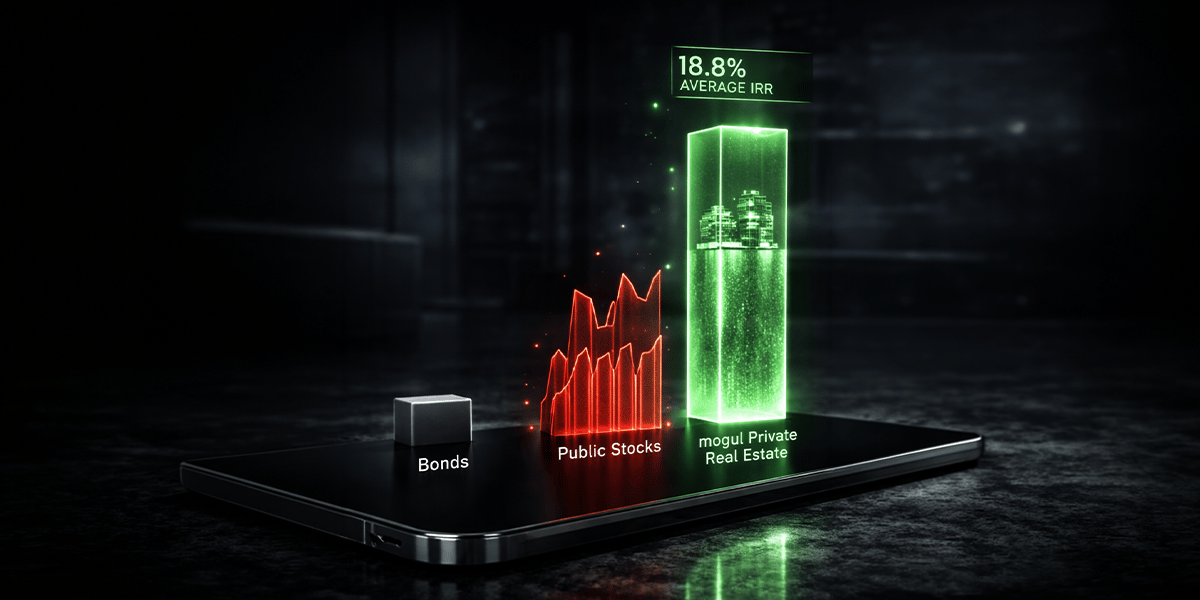
Why settle for 2% dividends when Wall Street dominates a $4 trillion market yielding 3x that? You can access the Goldman Strategy thanks to mogul.
They let you invest in elite rentals for less than the cost of a new Rolex. The Ex-Goldman veterans who handled $10 billion of institutional capital even pick the properties and manage them for you. That means all you need to do is watch the rent checks hit your bank account and relax.
Here’s The Breakdown:
7-12% Annual Cash Yields
18.8% Average Annual IRR for superior long-term growth.
Full Tax Benefits of direct real estate ownership.
Stop watching from the sidelines while institutional giants harvest the yield in your neighborhood. Secure your share of the most resilient asset class on earth today.
Past performance isn't predictive; illustrative only. Investing risks principal; no securities offer. See important Disclaimers
Before we dive deeper into the mechanics of the current oil-gold decoupling, it is worth addressing the fundamental question every professional investor is asking right now: How do you generate consistent yield when traditional "safe havens" are being liquidated?
In a market defined by "higher-for-longer" rates and violent shifts in inflation expectations, manual portfolio rebalancing is no longer fast enough. This is why we are highlighting the Alpha Factory Income strategy—a fully automated, systematic approach designed specifically for the macro dynamics we are seeing today.

Why Alpha Factory Income is Built for This Moment
The current environment is a "war of attrition" for capital. Alpha Factory Income doesn’t just sit in cash; it aggressively pursues income generation via dividends while shielding your principal from the high-variance swings currently hitting the commodities and tech sectors.
Dynamic Inflation Adaptation: The strategy doesn't just hold bonds; it balances a sophisticated basket of assets—including TIP (Inflation-Protected Treasuries), BIL (Ultra-short T-bills), and UUP (the US Dollar Bullish Fund)—to capitalize on the exact dollar strength currently weighing on gold.
Momentum-Driven Yield: By trading dividend-focused powerhouses like VIG and VYM, the system captures equity-like income with significantly lower drawdowns. It uses momentum signals to rotate out of high-risk sectors and into stable, higher-yield bond ETFs like HYG and EMB when the data dictates.
Low-Variance Architecture: The primary goal isn't just growth; it's capital preservation. Through a mix of domestic and international bond ETFs (including AGG, BNDX, and VCIT), the strategy creates a "shock absorber" for your portfolio, maintaining low volatility even when geopolitical tensions spike.
In an era where "Easy Mode" investing has been retired, Alpha Factory Income offers a disciplined, algorithmic way to stay ahead of the curve. It turns the current volatility into a source of steady, predictable yield.
The Oil-Inflation Feedback Loop
In March 2026, QatarEnergy's critical gas facilities at Ras Laffan Industrial City and Mesaieed suffered "extensive damage" and "sizeable fires" following a series of Iranian missile and drone attacks. The strikes—occurring primarily on March 2 and March 18–19—have forced the world's leading exporter of liquefied natural gas (LNG) to halt production and declare force majeure on long-term supply contracts.
Officials estimate a loss of 17% (approx. 12.8 million tonnes per year) of Qatar's LNG export capacity for three to five years, while officials estimate a loss of 17% (approx. 12.8 million tonnes per year) of Qatar's LNG export capacity for three to five years.
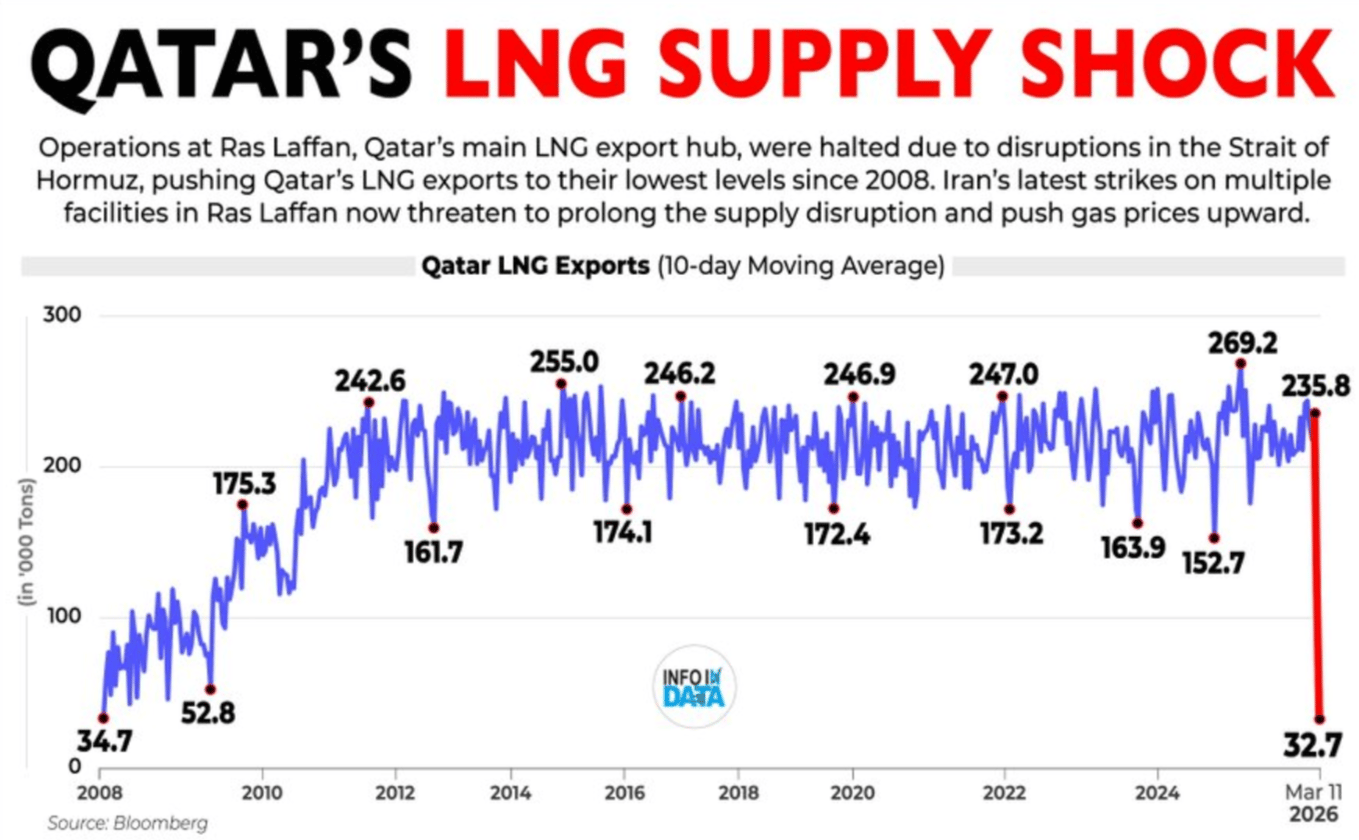
This sudden evaporation of supply has sent shockwaves through the energy complex, but the real story for investors isn't just the price of a barrel—it’s the inflationary feedback loop that has now been triggered.
Energy as the "Master Input"
When energy prices spike, they don’t move in a vacuum. Unlike a luxury good or a specific tech stock, energy is the "master input" for nearly every physical good on the planet. The disruptions along the Hormuz Strait have effectively raised the floor for global manufacturing and logistics costs overnight.
The Freight Multiplier: As oil surges toward triple digits, the cost of bunkering for global shipping and jet fuel for air freight is being passed directly to the consumer. We are no longer talking about "transitory" supply chain hiccups; we are looking at a structural increase in the cost of moving goods.
The Fertilizer Crisis 2.0: Because natural gas is a primary feedstock for nitrogen-based fertilizers, the 17% hit to Qatar’s capacity is already reflecting in agricultural futures. High energy prices today mean more expensive bread and produce six months from now.
The Return of the Wage-Price Spiral
For the macro-investor, the most dangerous aspect of this feedback loop is its impact on inflation expectations. When consumers see the price at the pump and the utility bill jumping 30% in a month, they demand higher wages.
This creates a self-fulfilling prophecy:
Energy Spikes: Production and transport costs rise.
Price Pass-Through: Companies raise prices to protect margins.
Wage Demands: Workers seek higher pay to maintain purchasing power.
Sticky Inflation: The "Great Plateau" of interest rates we expected to end has now become a permanent fixture of the 2026 landscape.
This is the primary reason gold is failing to catch a bid despite the chaos. In a context where energy-driven inflation is rampant, the Federal Reserve has no choice but to stay "aggressive for longer." The "inflation hedge" that gold usually provides is currently being neutralized by the "yield penalty" imposed by a hawkish central bank fighting the very oil surge we are witnessing.
Why Gold is Losing to the "Yield Monster"
Gold has often been referred to as the "ultimate insurance policy." But even the best insurance policy becomes a burden if the premiums get too high. Right now, the "premium" for holding gold is the Opportunity Cost, and the market expects this to keep climbing now that the Federal Reserve seems to be significantly slowing its rate-cut cycle this year.
For much of 2024 and 2025, the bull case for gold was built on the assumption that interest rates had peaked and were on a one-way slide down. That narrative just hit a brick wall. Following the March 2026 FOMC meeting, Chair Jerome Powell made it clear: persistent inflation—supercharged by the energy crisis—means the Fed is in no hurry to ease. This obviously changes the whole gameplan.
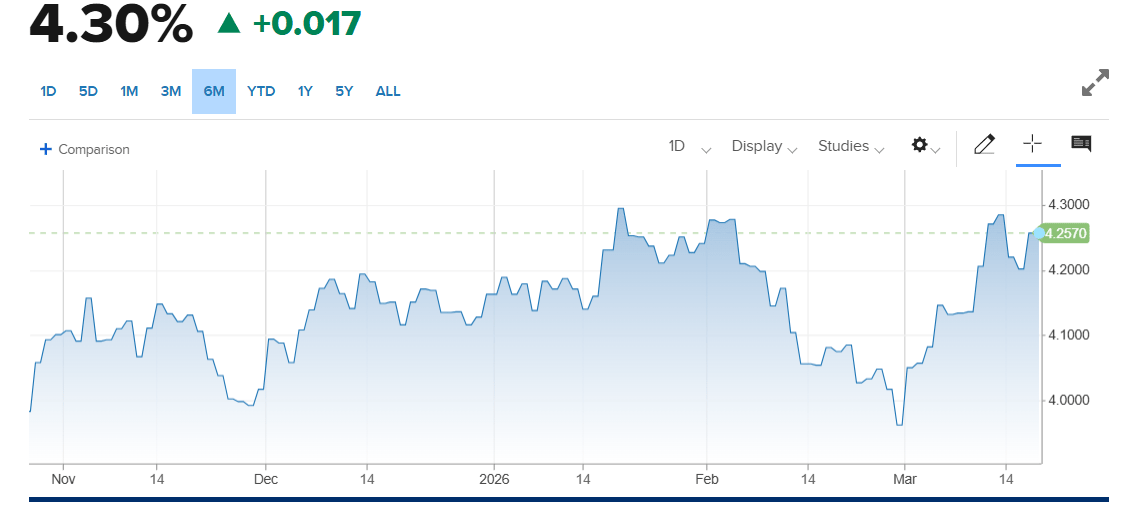
The 4.25% Hurdle: With the 10-year Treasury yield surging back toward 4.26%, the "Yield Monster" is officially back. Gold, which provides zero interest and zero dividends, is struggling to compete with a government-backed bond that pays a guaranteed, high-single-digit return.
Real Rates Turn the Screws: It isn't just nominal rates that matter; it's Real Yields (interest rates minus inflation). As the Fed stays hawkish to combat the oil spike, real rates are climbing, creating a mechanical drag on gold prices. Historically, when real yields rise, gold falls—and we are seeing that correlation play out with clinical precision.

The "Dollar as a Weapon"
Compounding gold’s misery is the relentless strength of the US Dollar Index (DXY), which recently reclaimed the 100 mark. Because gold is priced in dollars globally, a stronger greenback makes the metal exponentially more expensive for foreign central banks and investors in Europe and Asia.
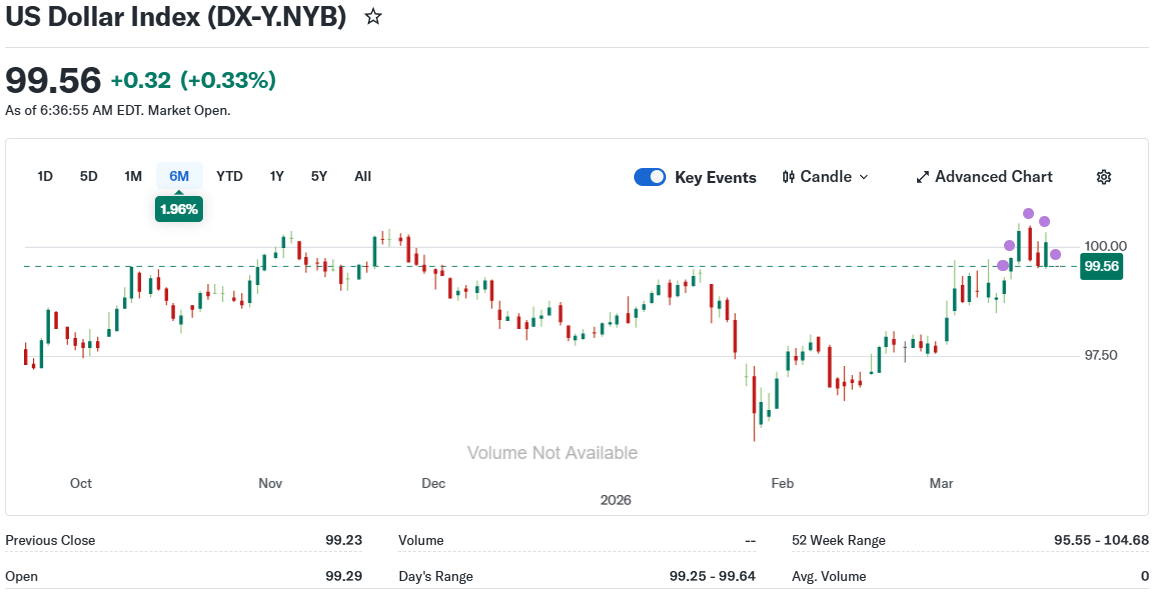
In this specific crisis, the market has decided that the USD is the "safer" haven. While gold offers protection against system collapse, the Dollar offers something more immediate: liquidity and yield. Investors are currently choosing the shield that pays them to hold it.
Investor Outlook: The Liquidity Trap
There is an old adage that goes, “when the paddy wagon comes, they take the good girls as well as the bad.” We are currently seeing this play out in the gold market.
As the Middle East conflict intensifies and oil pushes toward $150, the resulting shock to the bond and equity markets has triggered a dash for cash. Because gold has been the standout performer of the last 48 months—climbing toward that historic $5,300 mark—it has become a victim of its own success.
Large funds facing margin calls on bleeding tech stocks or devaluing bonds are liquidating their gold positions to shore up balance sheets. This is the Liquidity Trap: gold isn't being sold because its thesis has failed, but because it is the only asset with enough "meat on the bone" to provide immediate capital.
The Macro Forecast: Higher, Longer, and Harder
The Federal Reserve’s March 2026 decision to hold rates steady at 3.5%–3.75% confirms that the "pivot" many hoped for is being postponed by the energy-driven inflation spike. The Fed has even revised its year-end PCE inflation forecast upward to 2.7%, signaling that they are in no rush to ease.
What this means for your portfolio:
Tactical Oil Exposure: As long as the Strait of Hormuz remains a flashpoint, oil acts as a direct hedge against geopolitical escalation. It is no longer just a commodity; it is a "risk-on" surrogate for inflation protection.
The Gold "Floor": Technical support is currently firming up around the $4,550 range. While the short-term trend is painful, the structural drivers—central bank de-dollarization and massive sovereign debt—remain unchanged.
The USD Dominance: For the moment, the US Dollar has reclaimed its throne as the ultimate safe haven. Until energy prices stabilize or the Fed definitively signals a return to rate cuts, the "Greenback" will likely continue to suppress gold’s upside.
The current divergence is a stress test for the modern investor. While the "Fear Trade" has shifted its loyalty to Crude and the Dollar for now, history suggests that once the liquidity crunch subsides, the value of a non-sovereign, hard asset like gold will become undeniable once again. For now, patience is the only trade that pays.