- Surmount Markets
- Posts
- The "Magnificent 7" Meltdown: Is the Tech Premium Evaporating?
The "Magnificent 7" Meltdown: Is the Tech Premium Evaporating?
From the "Mag 7" Meltdown to the Bitcoin Barometer, Here is Your Playbook for the High-Stakes Weekend Ahead.

Logan Weaver
March 27, 2026
Sponsored by


The Mag 7 stocks have increasingly been experiencing a period of significant volatility and a notable "cracking" of their collective market dominance. While they previously moved in lockstep to drive market highs, they are now diverging into individual stories of massive AI spending versus immediate profitability.
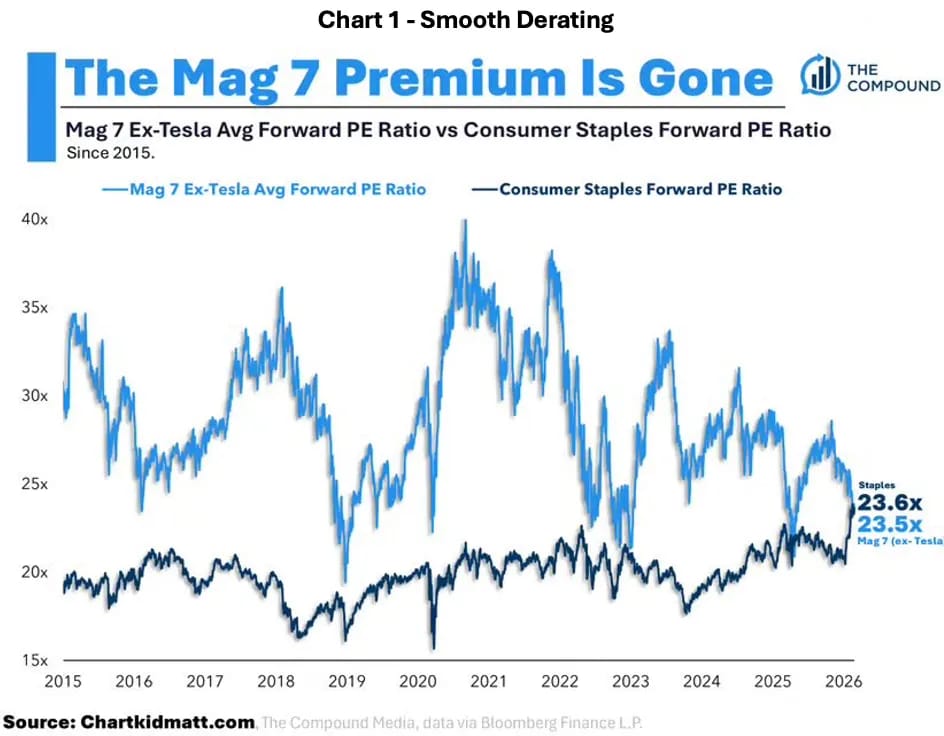
The current trends reveal expose how, when geopolitical tension reaches a boiling point, the very liquidity that makes Big Tech attractive also makes it the easiest "ATM" for panicking institutional investors. We are seeing a classic risk-off exodus, where the Nasdaq and S&P 500 are under the most severe pressure precisely because they are "top-heavy" with these seven names.
Instead of acting as a hedge against the conflict, the Mag 7 are leading the retreat. When the benchmarks drop to new war-time lows, it isn't the small-cap stocks doing the heavy lifting—it’s the giants.
The Amazon Indicator: A Warning Shot
Among the laggards, Amazon $AMZN ( ▼ 1.18% ) stands out as the session’s worst performer. This is a critical signal for investors to decode. Amazon is the ultimate "hybrid" stock—part high-margin cloud (AWS), part thin-margin logistics.
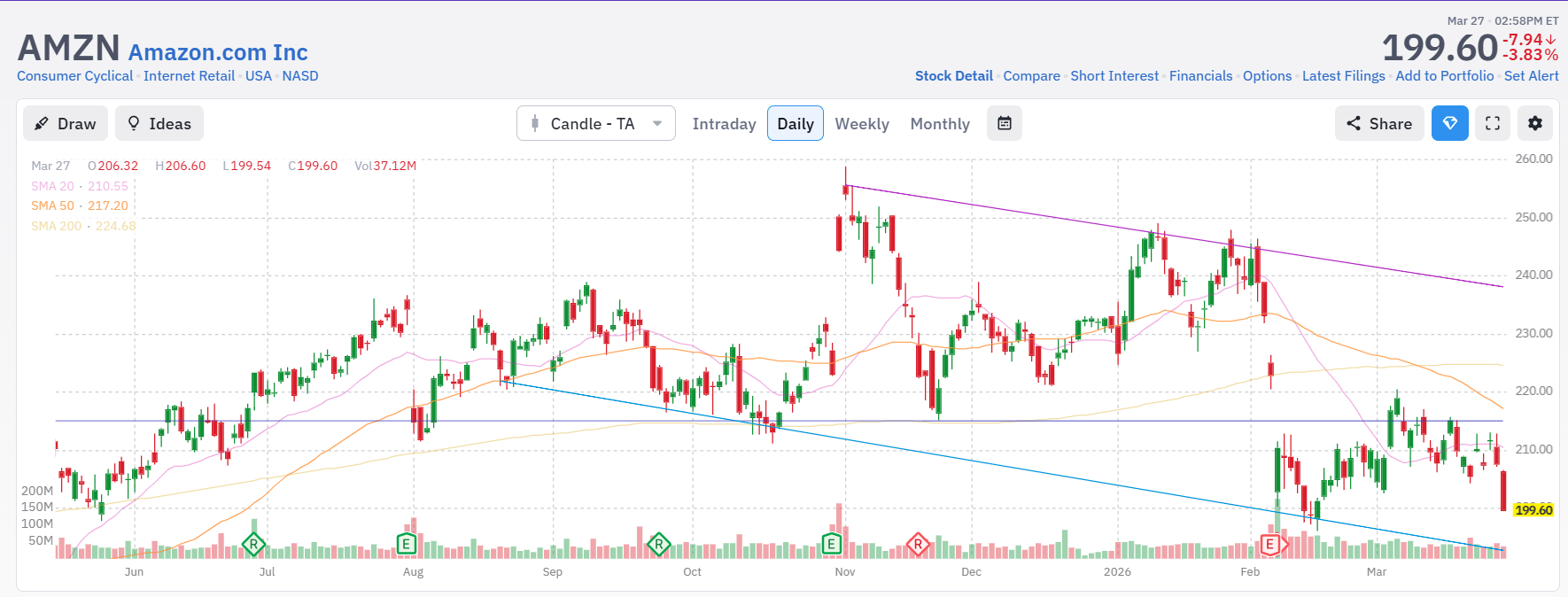
As Brent crude pushes past $110 per barrel, the market is pricing in a "Growth Trap." Investors are realizing that:
Fuel & Logistics: Sky-high energy costs eat directly into retail margins.
The Consumer Squeeze: If gas prices stay at these levels, discretionary spending on the Amazon platform will be the first thing families cut.
The "Pump-Fake" Penalty
The most painful part of this "meltdown" is the timing. Earlier this week, a brief pause in hostilities led to a "pump-fake" rally—a timid easing in sentiment that lured bulls back into the tech dip. Those who bought that bounce are now paying the consequences. As the Dow re-enters its bear channel and the Nasdaq tests its late-2025 support, the "Growth Trap" has officially snapped shut.
Your Billing System Wasn't Built for This

SaaS pricing has changed. Your billing stack probably hasn't. As usage-based and hybrid models become the default, finance teams are left stitching together spreadsheets, reconciling data manually, and closing books under pressure. The cost? Revenue leakage, audit risk, and forecasts no one trusts.
Our new Buyer's Guide for Modern SaaS Billing breaks down exactly what to demand from a revenue platform built for today's complexity — from automated usage billing to AI-native collections and rev rec. Whether you're evaluating vendors or rethinking your stack, this is your framework for getting it right.
Strategy Spotlight: The Bitcoin Momentum Follower
In a market where traditional exchanges slam their doors shut on Friday afternoon, leaving investors to stew over geopolitical headlines all weekend, the "old way" of investing is failing. While the Mag 7 are tethered to the 9-to-5 grind of the NYSE, global sentiment never sleeps. This is why the Bitcoin Momentum Follower isn't just an add-on—it’s the "barometer" your portfolio needs to survive 2026.
Why Momentum is the Ultimate Hedge
Bitcoin has proven itself as the primary real-time liquidity gauge. When tensions escalate—like the current arrival of the 4,500-strong Marine fleet—Bitcoin reacts first. The Bitcoin Momentum Follower allows you to stop guessing and start reacting with mathematical precision.
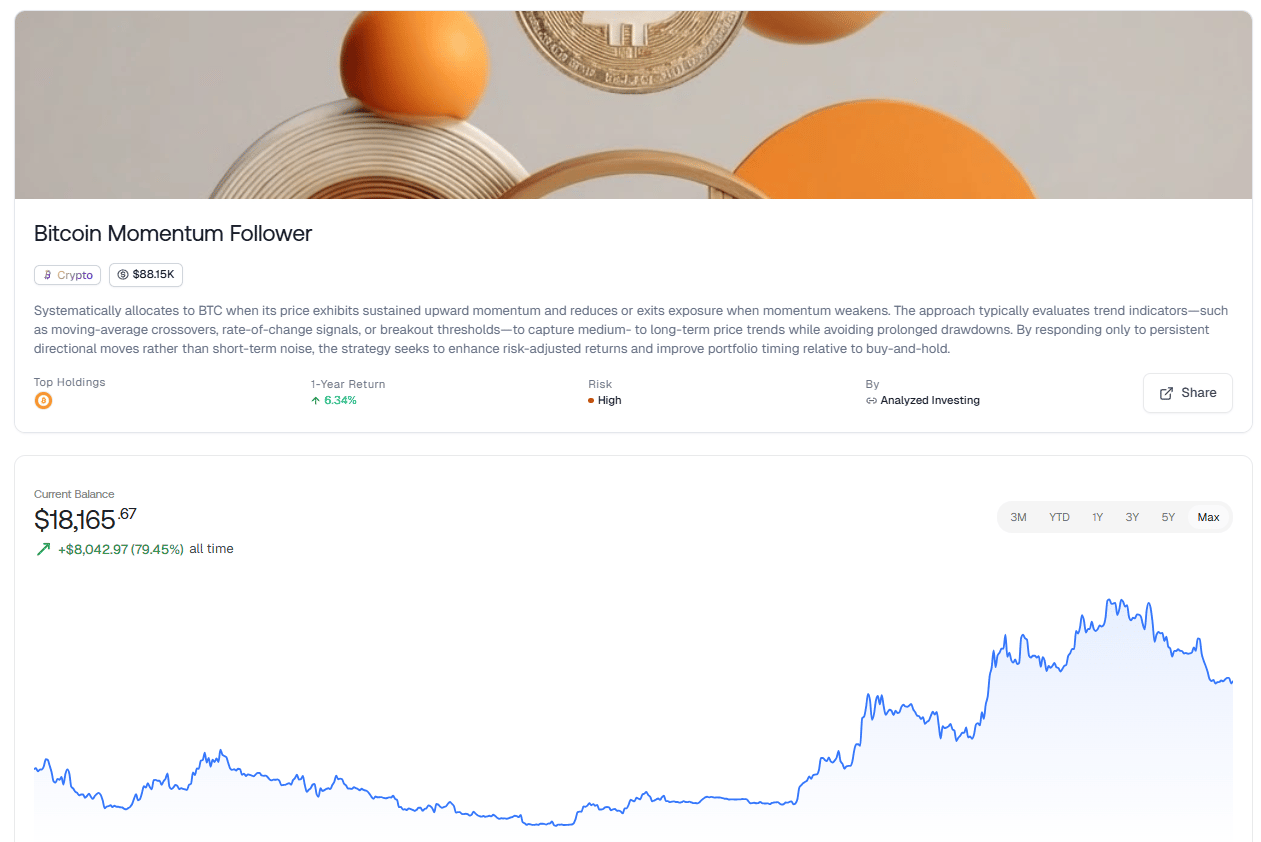
Instead of falling victim to the "pump-fakes" that trapped equity bulls this past Monday, this strategy uses sophisticated rate-of-change signals and moving-average crossovers to identify sustained trends. It ignores the short-term noise of a single headline, only deploying your capital when a directional move is persistent and powerful.
Winning the "Drawdown War"
The biggest threat to your wealth isn't a slow market; it's a "violent rebound" in volatility that leads to a 20% drawdown while you’re asleep. The beauty of this automated strategy lies in its exit logic:
Systematic Protection: When momentum weakens, the system reduces or exits your exposure automatically.
No Emotional Bias: It doesn't care about "HODLing" or "hoping" for a peace deal. It cares about price action.
Superior Timing: By capturing medium-to-long-term trends, it seeks to outperform a standard buy-and-hold strategy by sitting on the sidelines during the "choppy" bear phases we are seeing right now.
The Verdict: Automate Your Peace of Mind
If the S&P 500 breaks its 6,360 support or the Nasdaq slides toward 23,000, you don't want to be manually clicking "sell" while panic-refreshing Twitter.
Deploying the Bitcoin Momentum Follower to your portfolio means you have a 24/7 sentry guarding your capital. It captures the upside of the world’s most sensitive risk asset when the coast is clear and steps aside when the storm clouds gather. In a world of "minute-by-minute" headlines, momentum is the only truth..
The Oil vs. Innovation Tug-of-War
The primary catalyst for the current "Mag 7" meltdown isn't a lack of innovation; it’s the brutal physics of the energy market. As Brent crude surges past the critical $110 per barrel mark, it acts as a massive "tax" on the entire global economy, and high-growth tech is uniquely vulnerable to this pressure.
Inflation’s Return: The "Kryptonite" of Tech Valuations
Growth stocks, like those in the Magnificent 7, derive most of their value from future earnings. When oil spikes, it reawakens the "inflation monster," signaling to the market that interest rates may need to stay "higher for longer" to cool the economy.
Mathematically, when inflation expectations rise, the "discount rate" used to value those future tech profits also rises. This shrinks the "Net Present Value" of companies like Alphabet or Microsoft almost instantly. Simply put: A dollar earned in 2030 is worth significantly less to an investor today if oil-driven inflation is eating away at its purchasing power.
The Logistics Nightmare: Why Amazon is the Canary in the Coal Mine
While all tech is feeling the heat, Amazon (AMZN) is currently the worst performer for a very tangible reason. Unlike a pure software play, Amazon is a logistics and shipping empire.
Fuel Surcharges: Every cent added to a gallon of jet fuel or diesel cuts directly into Amazon’s thin retail margins.
Consumer Squeeze: As the 4,500-strong Marine fleet heads to the Middle East and energy prices climb, the average consumer spends more at the gas pump and less on the Amazon app.
The "Rotation Trade": From Innovation to Insulation
The most telling part of today’s heatmap isn't just that tech is down—it’s where the money is going. While the Nasdaq bleeds, Utilities and Industrials are rising.
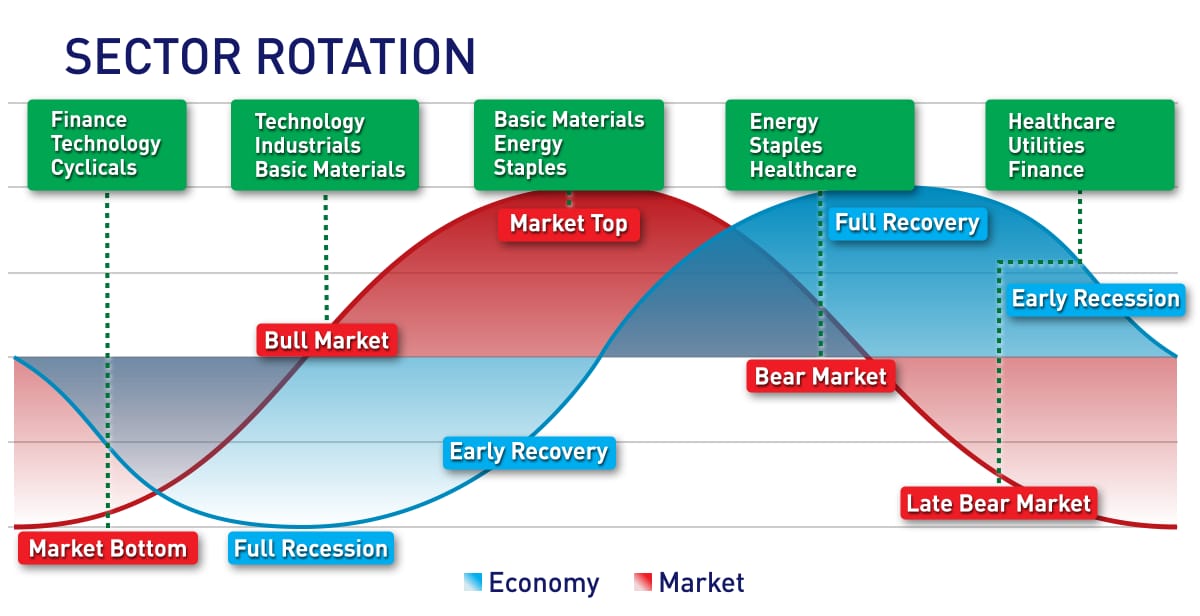
This is a classic "Rotation Trade." Investors are moving away from Innovation (high-risk, high-reward growth) and toward Insulation (defensive companies with "moats" and essential services). In a world of $110 oil and geopolitical anxiety, a utility company that keeps the lights on feels like a much safer bet than a tech giant trying to sell the next iteration of the Metaverse.
Technical Fractures: Breaking the 2026 Ranges
To understand if the tech premium is truly evaporating, we have to look past the headlines and into the "plumbing" of the market: the technical charts. For most of early 2026, the Magnificent 7 provided a floor for the Nasdaq, keeping the index within a predictable trading range. As of today, that floor is cracking.
The Nasdaq’s "Line in the Sand"
The Nasdaq (CFD) is currently testing a pivotal support level between 23,300 and 23,400—a zone that acted as the launchpad for the record-breaking rally at the end of 2025. Technical traders call this "polarity"; what was once a ceiling should now be a floor.
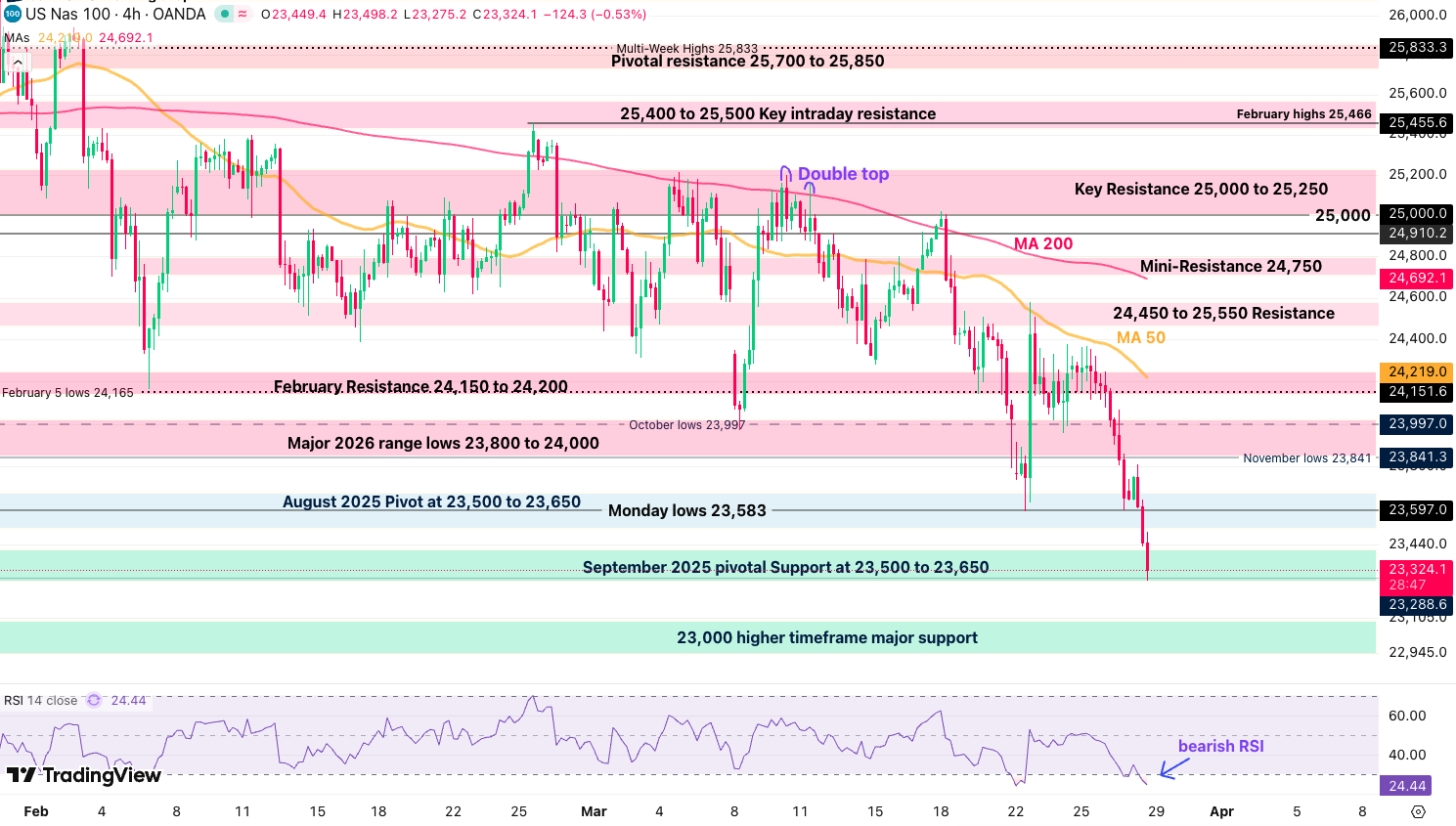
The fact that the index is struggling to hold this level despite the "pump-fake" rally earlier in the week is a massive red flag. If the Nasdaq fails to defend this September 2025 support, a "measured move" points toward a drop to 23,000. For investors, this isn't just a number; it represents the point where the 2026 "bull narrative" officially shifts into a correction phase.
The Weekend Gap Risk
One of the most dangerous elements of the current technical setup is the timing. With the 4,500-strong Marine fleet moving into position and the market awaiting an Iranian counterproposal, we are entering a "headline vacuum" over the weekend.
Because traditional markets are closed, we look to Bitcoin $BTC ( ▼ 1.38% ) . If Bitcoin breaks lower during the Saturday/Sunday sessions, it often foreshadows a "gap down" at the Monday open for tech stocks.
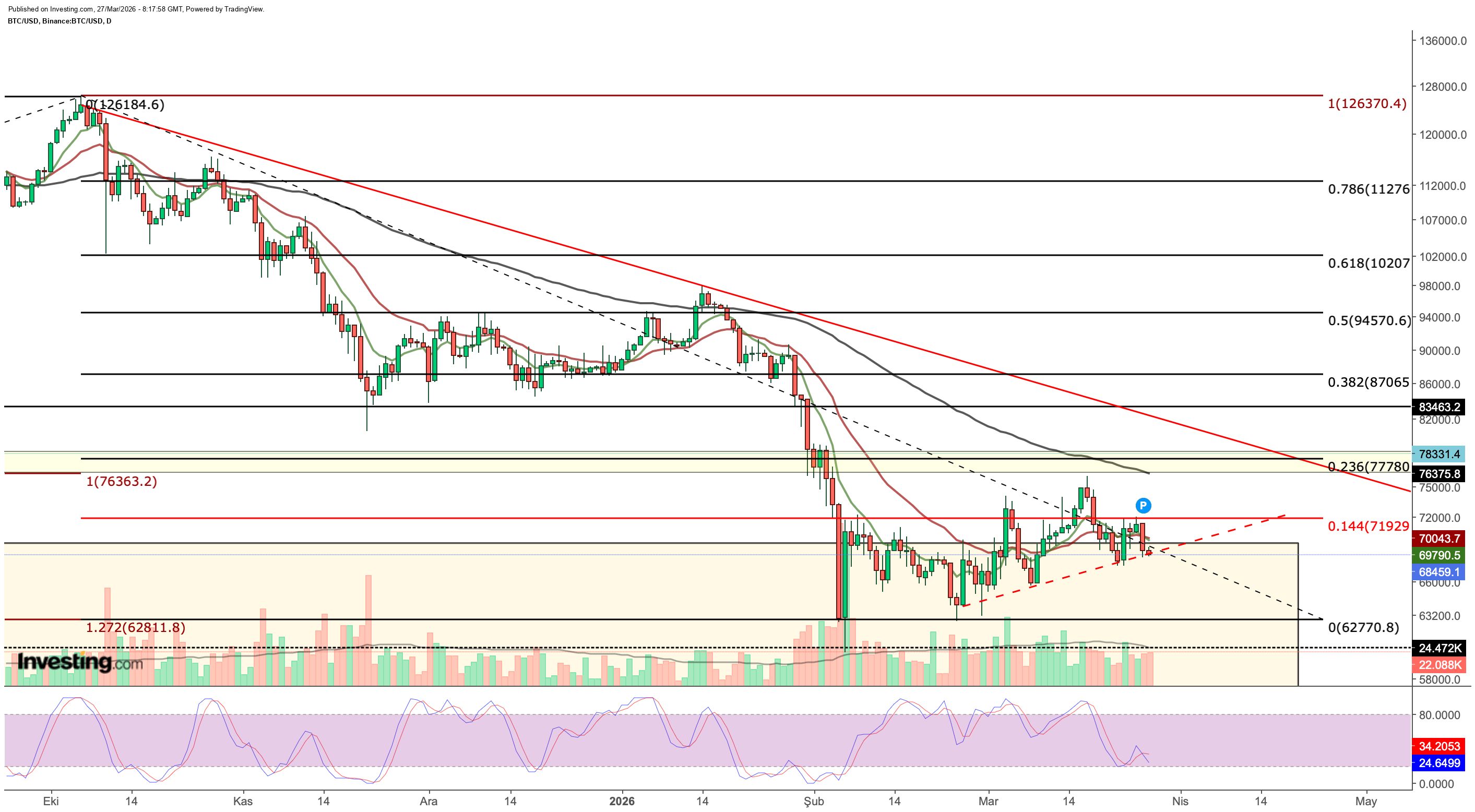
The Danger: If the Nasdaq gaps below 23,000 on Monday, it bypasses the opportunity for investors to sell at "limit" prices, often leading to a cascade of automated stop-loss orders.
S&P 500: Breaking the War Lows
The S&P 500 has already provided a grim preview, officially breaking its prior "war lows" and extending further into its downward channel. Currently sitting about 8.5% below its All-Time High (ATH), it is flirting with the "10% Correction" territory.
From a technical standpoint, if the index cannot find significant buyers at the 6,360 to 6,380 range (the August 2025 support), the technical "premium" associated with the Mag 7—which makes up a massive portion of this index’s weighting—will be effectively erased, forcing a fundamental repricing of the entire US equity market..
Investor Outlook: Tactical Exit or Generational Opportunity?
As the dust settles on this week’s session, investors are left with a binary choice: is the Mag 7's retreat a "fire sale" on the future, or the first stage of a multi-month valuation reset?
The answer depends entirely on your time horizon and your tolerance for geopolitical "gap risk."
The Case for the Tactical Exit
For the short-to-medium-term trader, the technical damage is hard to ignore. The Nasdaq’s failure to hold its August pivots and the S&P 500 breaking its "war lows" suggest that the path of least resistance is currently down.
Concentration Risk: If your portfolio is 40% or more tied up in the Mag 7 (common for those holding QQQ or SPY), you aren't diversified—you are a "tech-beta" speculator.
The "Energy Tax": With Brent crude at $110, every dollar increase acts as a tax on the margins of companies like Amazon and Tesla. Until energy prices stabilize, tech's P/E multiples will remain under heavy gravity.
The Case for a Generational Opportunity
For the long-term "buy and hold" investor, these are the moments where legendary wealth is often built.
Quality over Hype: While the Mag 7 are dropping as a group, their balance sheets remain some of the strongest in history. A "meltdown" allows you to pick up companies with billions in cash at a "geopolitical discount."
The 8.5% Reset: The S&P 500 is currently only -8.50% from its All-Time High. Historically, a "healthy" correction is 10%, and a "bear market" is 20%. We are entering the "Buy Zone" for those with a 5-year outlook, though catching the falling knife this weekend remains risky.
Final Strategy: The "Watch and Wait" Approach
Before making a move on Monday morning, use the weekend to watch Bitcoin (BTC-USD). If Bitcoin recovers while the Marine fleet arrival remains "priced in," it may signal that the worst of the fear is over. However, if the S&P 500 fails to hold the 6,360 to 6,380 support level, the "meltdown" may have more room to run.
The Verdict: This isn't the time for "all-in" bets. It’s a time for strategic rebalancing. Trimming over-extended tech positions to move into "defensives" like utilities or energy might not be exciting, but in a March 2026 market, it might be the only way to keep your portfolio from freezing over.