- Surmount Markets
- Posts
- No Ceasefire in Sight: Why Your Bitcoin Horizon May Have Just Shifted.
No Ceasefire in Sight: Why Your Bitcoin Horizon May Have Just Shifted.
Why geopolitical tension and the collapse of scarcity models have fundamentally reset Bitcoin’s value proposition for the high-stakes investor.

Logan Weaver
April 03, 2026
In partnership with


On the evening of April 1, 2026, President Trump took to the podium for a primetime address that many hoped would signal a de-escalation of the conflict with Iran. Instead, the rhetoric was decidedly hawkish. By vowing to "hit Iran extremely hard" and signaling that military operations would continue for weeks (without a clear timeline) the President effectively removed the "ceasefire premium" from the global markets.
The reaction was swift and unforgiving. We saw a classic "risk-off" pivot:
Equities: Global markets shuttered; while U.S. indices managed a volatile U-turn to close near flat, Asian markets—heavily reliant on energy imports—were decimated, with the KOSPI dropping 4.5%.
Commodities: Oil became the center of gravity. WTI Crude surged over 8% to nearly $108 per barrel, while Brent topped $110.
The Dollar & Yields: The U.S. Dollar Index rose to 0.5% as a flight to safety commenced, while the 10-year Treasury yield climbed to 4.384%, signaling that the bond market is bracing for a "toxic mix" of stagflation and prolonged high interest rates.

Bitcoin experienced a sharp sell-off, dropping over 2% to below $67,000 on April 2, with the speech reversing a brief rally, driving risk-off sentiment as investors braced for prolonged conflict, causing liquidation of leveraged positions.
For the crypto-investor, the fallout was a sobering reality check. Bitcoin did not move like gold (which remains buoyed by abnormal central bank buying); instead, it followed the Nasdaq into the red. This price action confirms a fundamental shift in the Bitcoin thesis, which is that the "maximalist" models based on scarcity are currently being overruled by the geopolitical cost of money. With no ceasefire in sight, the "digital gold" narrative is being stress-tested by a liquidity drain that forces us to rethink our investment horizons.
$1B Money Manager's Biggest AI Bet of 2026?

Louis Navellier called Nvidia at split-adjusted $4. He's calling this one now. An AI breakthrough he says could make ChatGPT obsolete — and trigger a 70X investment boom in the process. He's presenting the name and ticker symbol live. Watch free.
Strategy Spotlight: The Bitcoin Momentum Follower
If this week’s analysis has shown us anything, it’s that the "Buy and Hold" era of Bitcoin is being tested by a new, more complex economic reality. In a world of no ceasefires, shifting interest rates, and failing scarcity models, emotional trading is an investor's greatest liability.
The "maximalists" are waiting for a model to save them. The "panicked" are selling at the first sign of a dip. The smart money is automating.
That is we are highlighting the Bitcoin Momentum Follower strategy on Surmount.

This isn't a "set it and forget it" gamble. It is a systematic, high-performance tool built for the exact market environment we are in right now. Here is how it helps you win:
Precision Over Guesswork: Instead of trying to "time the bottom" of the Iran-Israel conflict, the strategy uses advanced indicators—like moving-average crossovers and breakout thresholds—to enter only when the trend is confirmed.
Drawdown Protection: While "HODLers" are bracing for potential 80% drawdowns, this strategy is designed to automatically reduce or exit exposure the moment momentum weakens, preserving your capital for the next leg up.
Emotionless Execution: When the headlines get loud and the 1Y Break-Even Inflation spikes, the Bitcoin Momentum Follower stays disciplined. It filters out the short-term noise and captures the medium- to long-term trends that actually build wealth.
The Opportunity:
Bitcoin has shifted into a high-beta macro asset. To maximize your returns in 2026, you need a strategy that moves as fast as the market does. Stop being a spectator to the volatility and start using it to your advantage.
Join the next generation of investors who prioritize data over dogma and protection over prayers.
Why Iran Matters to Your Digital Wallet
Many investors make the mistake of looking at the conflict in Iran as a "distant" geopolitical event. But with the current dynamics, the distance between the Strait of Hormuz and your digital wallet is nearly zero.
Here is how the "Energy Trap" is currently strangling Bitcoin’s price action:
The Inflation "Gravity Well"
The logic is simple but brutal. The closure of the Strait of Hormuz (which handles 20% of the world’s oil and LNG) and President Trump’s “back to the stone age” remarks have sent Brent Crude surging past $140 per barrel. This isn't just about the price of gas at the pump (though U.S. gasoline crossing $4.00/gallon this week is a significant psychological hit). It's about 1Y Break-Even Inflation (BEI).

Short-term inflation expectations have spiked above 5%. When inflation expectations rise, the Fed cannot cut rates. In fact, the market is now pricing in a "higher-for-longer" stance through the end of 2026. Since Bitcoin currently trades as a high-beta liquidity asset, every tick upward in energy-driven inflation acts like a lead weight on BTC’s price.

The Miner’s Dilemma
With Bitcoin, it’s important to keep in mind that we’re dealing with an entire industry. And this industry runs on electricity.
Squeezed Margins: With diesel and energy costs up as much as 70% since the conflict began, mining firms are facing a "dark spread" nightmare. Their costs are skyrocketing just as the BTC price has retreated to the $66,000 range.
The "Forced Sell" Risk: If energy prices stay this high and a ceasefire remains elusive, we face the risk of miner capitulation. Mining farms are tech companies with debt; if they can't pay the power bill, they have to sell their BTC treasuries. This creates a feedback loop of selling pressure that no "scarcity model" can prevent.
Ultimately, as long as the "no ceasefire" narrative dominates, Bitcoin will remain trapped in this energy-macro correlation. As such, BTC holders should be watching the energy infrastructure headlines and Fed Funds futures quite closely.
Value Note: The "Energy Trap" is a short-term liquidity crunch. It doesn't change Bitcoin's code, but it drastically changes the cost of holding it. If you aren't prepared for the volatility that comes with a $140+ oil environment, your horizon is likely too short for this asset class.
The "Miner Capitulation" Loop
As mentioned in the prior section, the real "gravity" pulling at Bitcoin right now is the mounting stress within the Bitcoin mining space. We are currently witnessing a classic "Miner Capitulation" Loop, with the high cost of energy increasingly becoming a permanent anchor.
The $80,000 Breakeven
As of this week, the weighted average cash cost to produce a single Bitcoin has surged to approximately $80,000. With BTC-USD currently hovering in the $67,000–$70,000 range, a significant portion of the network is officially "mining at a loss."
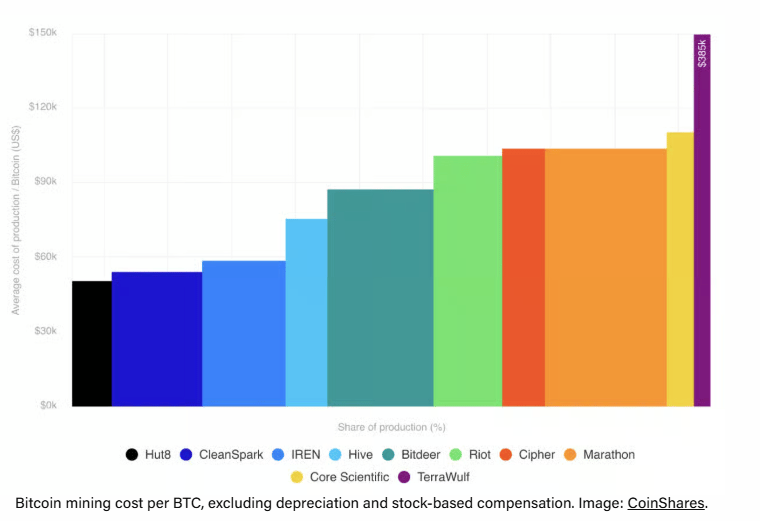
In previous cycles, miners could hold through these periods by taking out low-interest loans against their hardware. But with 1Y inflation expectations above 5%, cheap credit is not a part of the equation.
A Degenerative Feedback Loop
Of course, this creates a dangerous cycle for mid-cap mining firms:
Revenue Squeeze: Bitcoin prices stay below production costs due to macro uncertainty.
Forced Liquidation: To cover soaring electricity bills (inflated by the Iran conflict’s impact on global energy) and debt service, miners are forced to sell their BTC treasuries.
Sell Pressure: This "forced selling" hits the market regardless of demand, suppressing the price further.
The "Hashrate Reset": Eventually, the weakest players turn off their rigs. We are already seeing this; mining difficulty recently saw a rare downward adjustment to 133.79T as less efficient hardware goes offline.
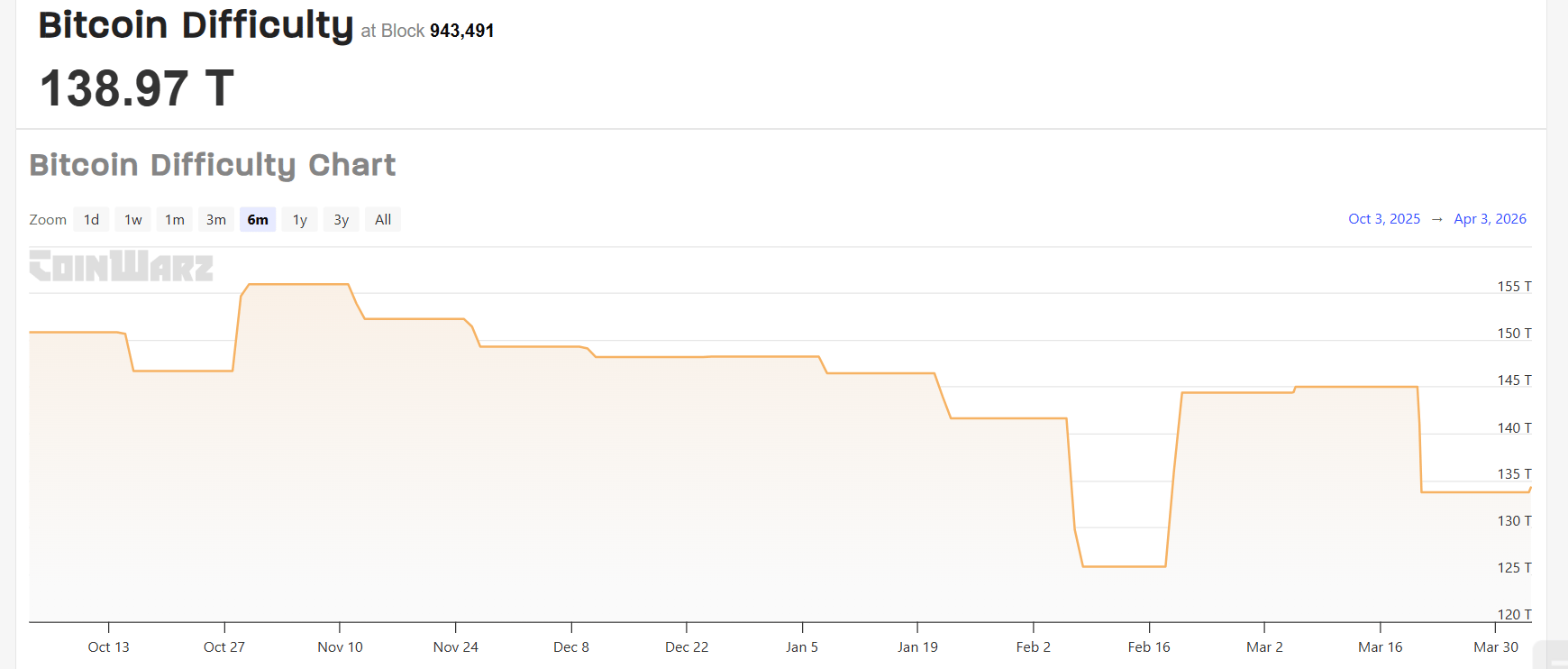
Why This is a "Value" Signal
For the disciplined investor, this "loop" is actually a healthy, albeit painful, reset. Capitulation is the market’s way of transferring Bitcoin from weak hands (distressed miners) to strong hands (institutional buyers).
We are currently in the "Survival of the Fittest" phase. Watch the Puell Multiple and Difficulty Ribbon. When the hashrate finally stabilizes and the "forced selling" dries up, the supply shock from the 2024 halving will finally be allowed to express itself. Until then, the mining industry is providing us with a rare valuation gap—if you have the stomach to wait for the loop to finish.
The 5-Year Horizon: Strategic Arbitrage
The most dangerous thing an investor can do in in the current situation is to mistake a macro adjustment for a structural collapse. While the headlines focus on the lack of a ceasefire and the "death" of scarcity models, the smart money is looking at the valuation gap that usually appears at the end of a tightening cycle.
The Breakeven Divergence: While 1-year inflation expectations have spiked to 5% due to energy shocks, the 5-year Breakeven Inflation (T5YIE) sits at 2.57%. This tells us the market believes the conflict-driven inflation is a "spike," not a permanent shift. Historically, Bitcoin thrives when real rates begin to stabilize after such a spike.
The Production Cost Floor: Currently, Bitcoin is trading around $66,500, while some institutional estimates (including JPMorgan) place the average production cost closer to $77,000. When the market price falls significantly below the cost to "create" the asset, it signals a period of miner capitulation. This is the "cleaning of the house"—inefficient miners exit, and the supply side of the network becomes leaner and more resilient.
Institutional Inflows are Returning: Despite the volatility, March 2026 saw the first monthly net inflow into Bitcoin ETFs ($1.32 billion) after four months of outflows. Wall Street isn't selling the "war news"—they are accumulating at the $60k support levels.
The Bottom Line:
For the weekly trader, the escalations in Iran are a reason to panic. But for the high-value investor, this is Strategic Arbitrage. You are buying an asset that is currently "mispriced" by war-induced fear, while the long-term monetary easing and institutional adoption cycles remain fully intact.
If your horizon is 5 years, the current "unexpressed scarcity" is like a coiled spring. The "maximalist" models might be broken, but the monetary reality of Bitcoin as a finite liquidity sponge remains the best play for the second half of the 2020s.